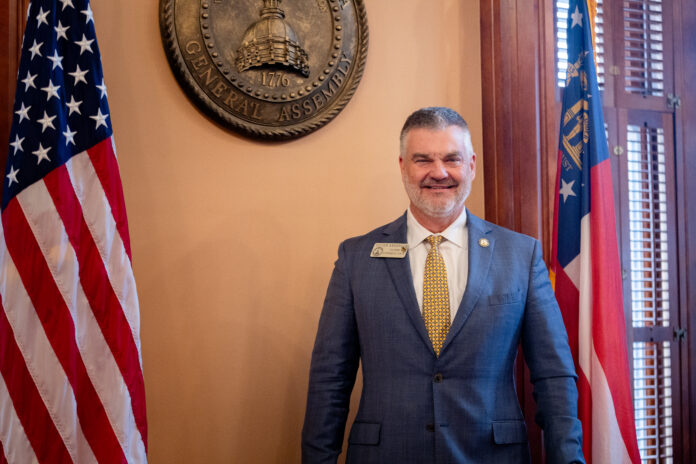
ATLANTA, Ga. — Property tax relief for Georgia homeowners remains a priority for lawmakers this session, with local impacts in Habersham County shaped by how cities, counties and school systems responded to recent tax reform legislation, according to state Rep. Victor Anderson.
Anderson told Now Habersham his committee’s work is closely tied to concerns raised by House Speaker Jon Burns during the Georgia Chamber of Commerce’s Issues and Eggs breakfast on Jan. 14, where property taxes were highlighted as a growing issue for homeowners statewide.
“One of the primary focuses that we’re looking at is property tax relief for primarily homestead property owners and anybody that owns property, and that’s been a big issue in Habersham County,” Anderson said.
The discussion centers on House Bill 581 and House Bill 92, legislation passed in recent sessions aimed at easing the property tax burden while giving local governments flexibility in how they replace lost revenue.
HB 581
According to Anderson, all municipalities in Habersham County opted in to HB 581, as did Habersham County government. The Habersham County School System, however, chose to opt out.
“All the municipalities stayed in, the county stayed in, and the school system did opt out,” Anderson said. “Now, what that did, the school system was important to us as taxpayers, because that’s about 60% of your property tax bill. It goes to the school system.”
While the school system’s decision limits the immediate impact on homeowners, Anderson said the cities’ and county’s participation still leaves the door open for tax relief if voters choose to act.
“Having the counties and the city stay in it gives the option, if the voters choose to do it, to put an additional one penny sales tax,” he said. “It has to, dollar for dollar, reduce millage rate on homestead property.”
Under HB 581, local governments that opt in may seek voter approval for a one-cent sales tax dedicated to offsetting property taxes. School systems do not directly benefit from that sales tax, a key reason many districts across the state have been hesitant to participate.
“The school system gets nothing out of participating in that one penny tax to offset property tax,” Anderson said. “It would have the net effect of reducing property taxes. Yes, there’d be limited benefit to the school system.”
HB 92
Lawmakers addressed that concern during the 2025 legislative session with the passage of HB 92, which Anderson described as an incentive aimed at encouraging school systems to reconsider opting in.
“What we did this past session, in ’25, we passed House Bill 92, which gave a little bit of a carrot to the school systems for reconsideration,” he said.
Under HB 92, school systems that opt in may recoup certain sales and use taxes tied to capital projects, including taxes paid on equipment, materials and subcontractor purchases.
“If they opt in and participate in 581, then some of that can be recouped,” Anderson said.
Anderson added that lawmakers are continuing to study how the two bills are working together and whether additional adjustments are needed, particularly in counties like Habersham, where property taxes remain a top concern for residents.
“We’re still looking at how this plays out on the ground,” he said. “The goal is meaningful relief for homeowners, while giving local governments and school systems tools that make sense long term.”
The issue is expected to remain part of broader tax policy discussions as the General Assembly continues its work under the Gold Dome this session.